Arc Length Continuation in PETSc
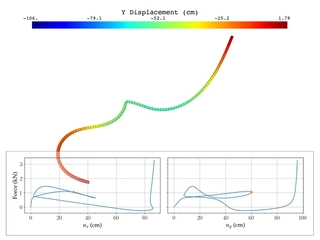 Buckling Behavior of a Lee Frame with SNESNEWTONAL
Abstract:
Traditional Newton methods with load and displacement control are unable to solve problems with limit points, bifurcations, and snap-through instabilities. Arc-length continuation methods are a powerful tool for solving these problems, but are not natively supported in PETSc (Portable, Extensible Toolkit for Scientific Computation). This work implements two arc-length continuation methods in PETSc: Crisfield’s method with partial corrections and the normal-plane constraint method. Due to the composable nature of PETSc solvers, these methods can be used as a replacement for pseudo-time stepping approaches to static problems or as a composed solver for quasistatic and dynamic problems with time integration. To support the latter, this work implements a novel method for bounding the load parameter with a hybrid arc-length and Newton method in the final increment. The implementations are verified using a 3D large deformation buckling test, where they outperform the standard Newton method with pseudo-time stepping in terms of convergence and accuracy.
See the write-up and code for the Lee frame example!
